Xiamen Lith Machine Limited is a technology-based enterprise, integrating R&D, manufacturing, sales and service. Our company has strong scientific research strength, including more than 20 senior mechanical and electrical engineers, 8 external experts and professors, and more than 160 front-line technical workers.
Microwave Muffle Furnace: A High-Precision Thermal Processing System for Advanced Laboratory Applications
The Microwave Muffle Furnace is an innovative thermal-processing instrument designed to enhance laboratory efficiency through the integration of microwave heating technology with the classical muffle-furnace architecture. This hybrid approach allows for rapid temperature rise, uniform heat distribution, and precise thermal control, making it ideal for applications such as ashing, calcination, heat treatment, loss-on-ignition (LOI) testing, and material decomposition. By combining traditional high-temperature performance with microwave dielectric heating, the microwave muffle furnace addresses longstanding challenges associated with slow heating rates, high energy consumption, and uneven temperature distribution found in conventional systems.
At the core of the microwave muffle furnace is the principle of microwave dielectric heating, wherein electromagnetic waves—typically at 2.45 GHz—interact with polar molecules within the sample or susceptor materials. This interaction generates volumetric heating, enabling rapid thermal response and reducing overall process time. Unlike conventional furnaces, which heat the material externally through radiant and convective mechanisms, the microwave muffle furnace promotes internal heating, minimizing temperature gradients and improving repeatability.
The furnace’s structure centers around its muffle chamber, a thermally insulated enclosure typically constructed from high-grade refractory ceramics such as alumina, mullite, or silicon carbide. These materials provide excellent thermal stability while being engineered to be partially or fully microwave-transparent, depending on the application. The muffle serves as a protective barrier that isolates the sample from direct microwave exposure when necessary, while still allowing controlled heat transfer. This ensures that sensitive materials can be processed safely and uniformly, even under aggressive thermal conditions.
To generate microwaves, the furnace employs a magnetron or solid-state microwave source, capable of delivering stable and adjustable power levels. The microwave energy is guided through a precisely engineered waveguide system, which directs the radiation into the heating chamber. Depending on the furnace design, a mode stirrer, rotating platform, or field-homogenization structure ensures uniform electromagnetic distribution, preventing hot spots and enhancing overall heating uniformity.
Because many laboratory processes require temperatures exceeding the natural limits of microwave heating alone, the microwave muffle furnace incorporates supplementary heating elements, typically high-temperature electric heaters. These elements, embedded within the furnace insulation or chamber walls, provide additional thermal energy to achieve temperatures commonly in the 600–1200°C range. The combination of microwaves and traditional heating elements allows for faster ramp rates, reduced energy consumption, and more stable plateau temperatures than conventional furnaces.
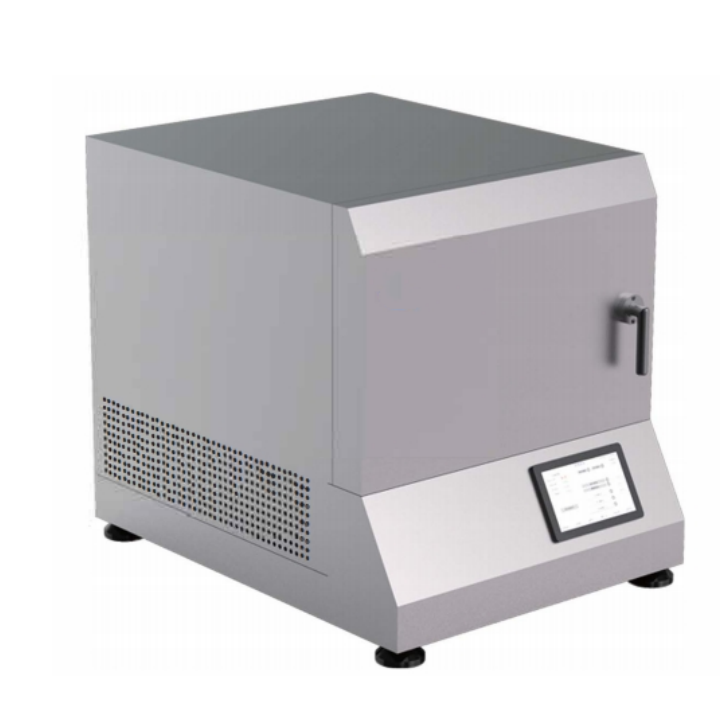
Muffle Furnace
One of the defining advantages of the microwave muffle furnace is its advanced temperature-control system. Equipped with infrared pyrometers, thermocouples, and microprocessor-driven controllers, the system can manage complex heating profiles with exceptional precision. Users can program multi-step heating sequences, maintain stable isothermal conditions, and regulate the balance between microwave and resistive heating. Real-time feedback loops ensure that thermal stability is maintained despite load variations or changes in sample composition.
Safety engineering plays an essential role in the furnace’s design. The system incorporates microwave shielding, multiple door interlocks, thermal-cutoff circuits, and over-temperature protections to guarantee safe operation. The muffle chamber itself serves as a key safety component, preventing direct microwave leakage and providing a robust containment environment for reactive or volatile samples. Additionally, integrated exhaust ports or optional fume-extraction systems allow for safe removal of combustion gases and volatile by-products generated during high-temperature processes.
In laboratory and industrial environments, the microwave muffle furnace provides significant advantages in terms of processing speed, thermal efficiency, and analytical accuracy. It is widely used in materials research, pharmaceutical analysis, environmental testing, coal and mineral assessment, metallurgical studies, and quality-control laboratories. Tasks such as LOI analysis, ceramic sintering, catalyst preparation, and combustion studies benefit from its rapid heating capabilities and uniform temperature distribution.
From an engineering perspective, the microwave muffle furnace represents a refined balance between electromagnetic science and mechanical thermal-design principles. Its hybrid heating architecture offers laboratories substantial reductions in process time, improved reproducibility, and lower operating costs. As scientific industries continue to demand faster, more reliable, and energy-efficient heat-processing equipment, the microwave muffle furnace stands out as a technologically advanced and highly dependable solution.
In conclusion, the Microwave Muffle Furnace is a state-of-the-art thermal-processing device that enhances laboratory productivity through superior heating performance, robust structural engineering, and advanced control features. Its combination of microwave technology with traditional muffle-furnace design makes it an indispensable tool for modern analytical and research environments.

 IPv6 network supported


 Tel : +86-592-3926659
 Email : gilia@inthelaboratory.com